Greenland
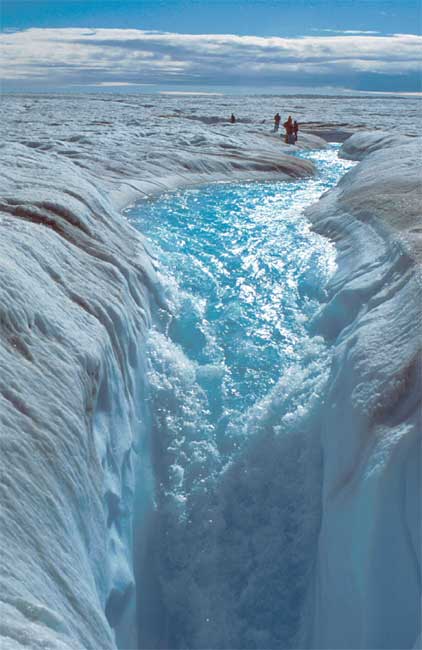
Melt water flows into a large moulin in the Greenland ice sheet. Image credit: Roger J. Braithwaite, The University of Manchester, UK. Image Source: NASA.
By far the largest chunk of ice in the Northern Hemisphere is the ice sheet that sprawls across most of the island of Greenland. This ice sheet covers an area more than twice the size of Texas — around 650,000 square miles — and it averages 1.6 miles thick (about 8500 feet). Like a gigantic mountain range, the ice of Greenland shapes weather patterns over a vast region as winds flow over and around it.
Warming temperatures are taking a toll on the Greenland Ice Sheet. Satellite data since the 1990s show that ever-larger amounts of ice have melted and/or flowed into the ocean. Since 2002, the yearly ice loss has averaged more than 200 gigatons (trillion metric tons). The summer melt season has increased by several weeks in some parts of Greenland over the last several decades. Warmer temperatures have allowed more atmospheric moisture to reach the frigid interior, so that snowfall there has been adding to the ice pack in spite of the island’s overall ice loss. Meanwhile, in a process called dynamic thinning, meltwater is percolating to the bottom of coastal glaciers, allowing them to slide toward the ocean more rapidly. Many of Greenland’s glaciers are also eroding more quickly where they meet the sea because of warmer ocean temperatures.
If the entire Greenland Ice Sheet were to melt tomorrow, global sea level would rise by an estimated 23 feet. Before the last ice age, about 120,000 years ago, roughly half of the ice sheet melted, in temperatures similar to those we may experience by the year 2100: about 3°C (5.4°F) above preindustrial levels. It would take centuries for this kind of warmth to again melt off a large part of the ice sheet. Such a development would inundate coastal cities where many millions of people live and work. Long before this devastating scenario, we will see the increasing effects of Greenland ice melt, as it is expected to contribute a few inches to sea level rise by the year 2100. The odds of a much larger acceleration in melting this century are considered to be lower for Greenland than for Antarctica (see our Antarctica page for more).
Along with raising sea level, meltwater from Greenland will also reduce the salinity of the nearby ocean surface, and this may act to slow the vast ocean currents that flow from the tropics to the North Atlantic. The IPCC considers it likely that the Atlantic Meridional Overturning Circulation will slow by 11-34% this century, largely because of Greenland meltwater. Such a slowdown would not be enough to trigger a “Day after Tomorrow” scenario, but it could reduce the rate of climate warming in and near the British Isles compared to other parts of the world.